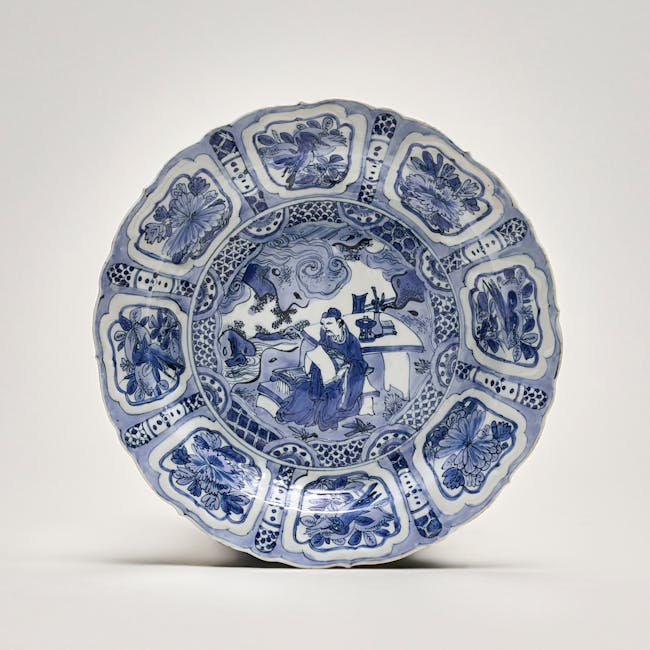
A finely potted and moulded plate, with shallow spreading sides and a wide foliate rim. Painted in the distinctive Kraak style, the decoration has outlines in an intense cobalt blue, with infill in paler hues. The cavetto has a finely painted scene of a scholar reading a scroll, in a garden with overhanging rocks. He is dressed in flowing robes and is seated next to a table with scholar’s accoutrements. The central scene is surrounded by a band of dense blue diaper. The sides and rim is divided into eight panels within blue foliate borders, decorated alternately with flowering plants and birds with fruit. In between are narrower panels with a diaper pattern and beaded pendants. The outside of the rim has loosely painted blue bordered foliate panels sparing decorated with a spray of fruit and one of the hundred treasures, interspersed with narrow panels with an elongated lingzhi fungus. The footring and bottom has some kiln grit which has adhered to the surface; the underside is undecorated and glazed. The bottom has a red lacquer seal impressed with an unidentified European family crest, an older inventory label with a black edge and a small round label (nr. 188a) from the Nieuwenhuys Collection.
According to the Kraak ware classification of Marina Rinaldi , this plate has shape c and border VII.1 – dating the plate to the early 17th century.
Kraak is the name given to a type of porcelain, usually blue and white, produced at the kilns in Jingdezhen at the end of the 16th and first half of the 17th century. Kraak wares were made almost entirely for the export market, though some has been found in China as well. It is recorded that large quantities were exported for trade to Holland through the VOC – who had managed to wrest control of the trade in Chinese porcelain from the Portuguese. There is a considerable variation in the quality of Kraak wares. The better quality pieces are finely potted, translucent and finely decorated – like this plate.